Iran says one of its largest medicine manufacturers has been 'destroyed'
Ghoncheh Habibiazad
Senior reporter, BBC PersianThe investment arm of Iran’s Social Security Organization (SHASTA), which provides healthcare entitlements and pension benefits, has said in a statement that one of the largest manufacturers of medicine in the country has been "destroyed and its production line has also been damaged".
In its statement, published by Iranian outlets, SHASTA has labelled it a "brutal act by the enemy" and said that it "clearly targets the lives and health" of the Iranian people.
Iranian Foreign Minister Abbas Araghchi has accused Israel of "openly and unashamedly bombing pharmaceutical companies", and has said that Iranian armed forces will "severely punish aggressors" in a post on X.
Iranian outlets and former foreign minister Javad Zarif have named the company hit as Tofigh Daru Research and Engineering Company.
The company is a member of SHASTA and is located in an area the Israel Defense Forces (IDF) had issued an evacuation warning for on its account in Persian on X.
The IDF has told me it is "still checking" regarding the claim by Iran that Israel has attacked the company.

Isfahan explosions so big they were seen by weather satellite
By Barbara Metzler and Richard Irvine-Brown
Some of the explosions near Isfahan in central Iran last night were so large they could be seen on weather satellite images, which can detect sudden changes in the level of light over large areas.
BBC Verify has analysed imagery from Meteosat-12, which shows cloud drifting over the city in central Iran before a white flash appears.
Frames from the feed show the light at 22:30 and 22:40 GMT (02:30 and 02:40 local time), suggesting there were fires or a series of explosions lasting over a period of at least 10 minutes.
While the flash itself appears small, the fires or smoke plumes which caused it must have been significant enough for it to register on the imagery.
In the most zoomed in version of the Meteosat-12 feed, each pixel covers 1 sq km (0.4 sq miles). Here’s a before and after image of two frames for you to compare:
Videos from Isfahan show likelihood of weapons storage sites being targeted
Vahid OnlineBy Richard Irvine-Brown and Joshua Cheetham
BBC Verify is continuing to analyse videos showing a series of explosions at Isfahan, in central Iran.
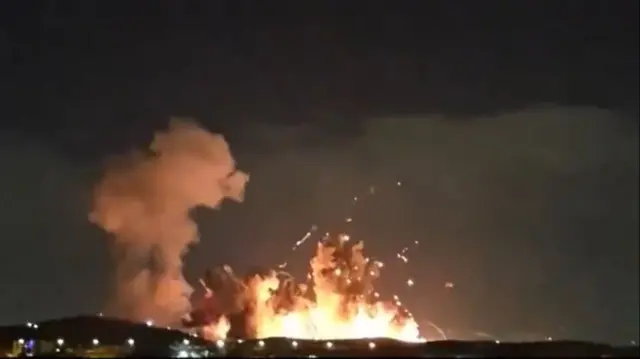
One video, which has also been shared by US President Donald Trump, shows fire and smoke from an explosion, followed by several secondary blasts. Defence Secretary Pete Hegseth said at a Pentagon news conference an "ammo depot" was "struck by US bombers".
We've located the blast to a walled-off compound between two air bases on the south side of the city.
We shared this and other videos we've verified with experts who agree they show weapons storage facilities being struck.
Experts at McKenzie Intelligence Services and the International Institute of Strategic Studies point out the secondary blasts are evidence of munitions "cooking off" where they explode due to the heat caused by an explosion.
Jackie Akhavan, professor of explosive chemistry at Cranfield University, said although there were no visible shock waves from high explosives the brown smoke seen in some videos "is evidence of nitrous oxide which is produced when a high explosive burns".
According to the defence intelligence company Janes and Justin Bronk of the Royal United Services Institute, targeting such facilities - likely to be underground - would require US heavy-penetration "bunker-buster" bombs.
European foreign ministers call on Israel to avoid 'further widening' conflict with Lebanon
The foreign ministers of 10 European countries have issued a joint statement calling on Israel to avoid a "further widening" of the conflict in Lebanon - asking it to respect the "territorial integrity" of the country.
The statement condemns Hezbollah's attacks on Israel in support of Iran, and says it supports and encourages the Lebanese government to "restore its sovereignty" over the whole of Lebanon.
It calls for "direct political negotiation" between Lebanon and Israel, saying all parties should "immediately deescalate".
Belgium, Croatia, Cyprus, France, Greece, Italy, Malta, the Netherlands, Portugal, the United Kingdom and the EU's foreign policy chief Kaja Kallas have all signed it.
Israel sent ground troops into southern Lebanon on 2 March and has also been launching broad strikes across the country. It says it is trying to protect communities from attacks by Hezbollah, which is an Iranian-backed armed group.
Under the ceasefire agreement that ended the war in 2024, Hezbollah was meant to disarm and leave its positions in the south.
Canadian PM denounces Israel's 'illegal invasion' of Lebanon
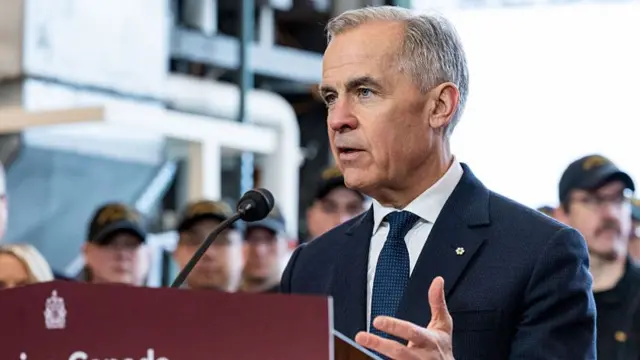
Getty ImagesCanadian Prime Minister Mark Carney has denounced what he calls Israel's "illegal invasion" of Lebanon.
Speaking in Quebec, he tells reporters: "It’s an illegal invasion, it’s an invasion of Lebanon, it’s a violation of their territorial sovereignty."
"From a practical perspective, the government of Lebanon has banned Hezbollah, is trying to take action against Hezbollah and their terrorist activities and their threats to Israel," he adds.
"That is the purported justification for this invasion, so we condemn it."
It comes as Israeli Defence Minister Israel Katz says the country will keep security control over parts of southern Lebanon even after the current war with Hezbollah ends.
Israeli officials say ground troops were moved into Lebanon to protect communities in northern Israel from Hezbollah attacks, with Katz previously stating that Israel was taking action because the Lebanese government had done "nothing".
Hegseth criticism of Nato reflects president’s anger that allies haven't stepped up in the way Washington wants
Gary O'Donoghue
Chief North America correspondentPerhaps the most telling moment of Pete Hegseth’s briefing earlier - the first in almost two weeks from the Pentagon, was when the secretary of defence was asked whether opening the Strait of Hormuz was an “essential” objective of the war.
He could have given a simple yes to that answer, instead he focused on degrading Iran’s missiles, its ability to project power and its nuclear capabilities.
Crucially on the strait he said: “it’s not just a US problem set, it’s not just us, other countries should pay attention.”
He said these other countries, meaning Nato - and including the UK - should, as he put it, “start learning to fight for yourself.”
The attacks on Nato allies are not surprising.
What is fascinating here is that it opens up the possibility that the US could declare its objectives met without the free flow of oil and gas reestablished through the strait.
An indication perhaps that this administration is prepared to settle for something less than complete and utter victory.
Criticism of Nato was threaded throughout the briefing. Pete Hegseth took a swipe at Britain’s Royal Navy, reflecting not just his but also the president’s anger that Nato allies and in particular the UK, have not “stepped up” in the way Washington wanted.
So here we are, another inflection point in the transatlantic relationship that threatens to widen an already deep rift.
Strikes in Beirut as Lebanon's death toll continues to rise
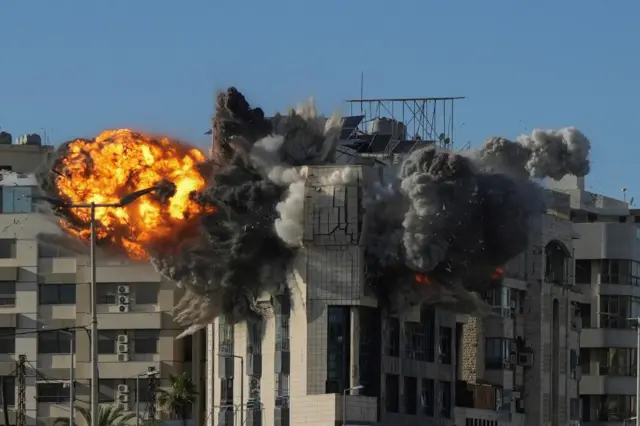
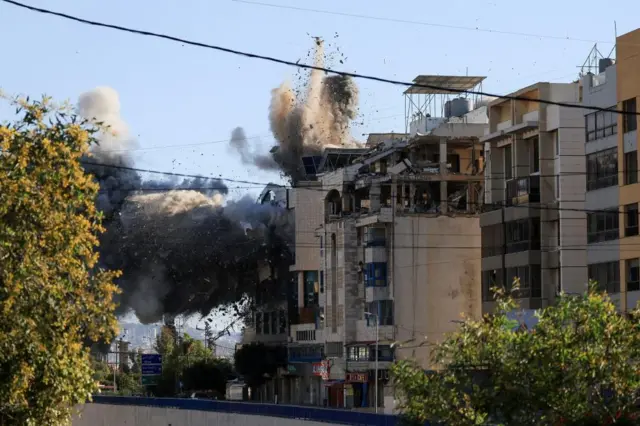
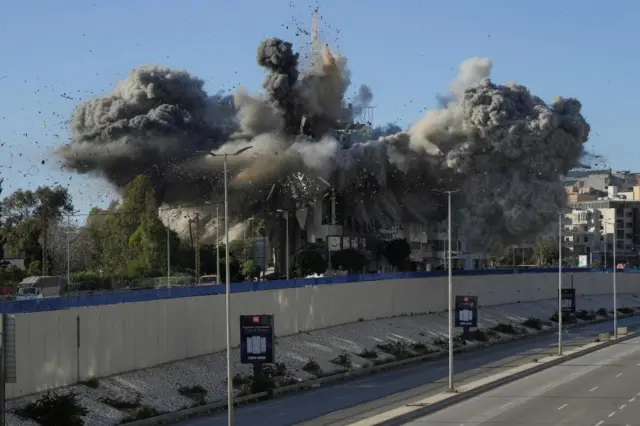
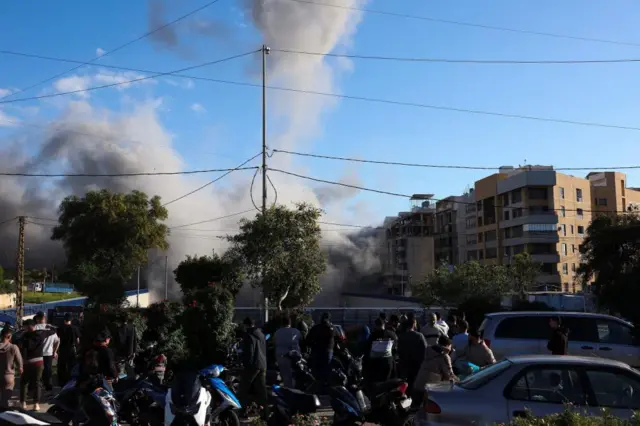
ReutersThere have been multiple explosions in Beirut today, with further Israeli strikes on the Lebanese capital.
The death toll in Lebanon has risen to 1,268 since 2 March, with a further 3,750 injured, according to the state-run National News Agency.
Israel has regularly launched strikes at Beirut and southern Lebanon since the war began, saying it is targeting sites associated with the Iranian-backed Hezbollah group.
ReutersReutersReutersItaly says requests to use military bases assessed on 'case-by-case basis’
Davide Ghiglione
in RomeEarlier, Italy reportedly denied a US request to use the Sigonella air base in Sicily for military aircraft a few days ago, in a move that underscores Rome’s cautious approach to involvement in military operations in the Middle East.
Following the reports, the Italian government now says in a statement that “all requests to use its military bases are assessed on a case-by-case basis in full compliance with existing international agreements and parliamentary guidance.”
It said no tensions have emerged with international partners, describing relations with the US as “strong and based on full and effective cooperation,” and confirmed it will continue to act within the framework of current treaties while safeguarding national interests.

Increasingly impatient tone of Trump's posts suggests he knows he's in a bind
Paul Adams
Diplomatic correspondentReutersDonald Trump’s insistence that allies, including Britain, should "go to the Strait, and just take" Iran’s oil may appeal to some of his more vociferous supporters, but in the midst of a war without an end in sight makes little sense.
Assuming the president does not mean that western partners should take control of Iranian oil – by seizing tankers or parts of Iran’s oil infrastructure – then he’s repeating a demand he’s been making for some time: that the time has come for countries to contribute to an escort mission through the Strait of Hormuz.
The problem is that few countries believe the president when he says "the hard part is done".
No-one is yet ready to challenge Iran’s chokehold over the strait. Not even US warships have done this.
With the president also saying that negotiations with Iran are going well – something of which, again, there’s little evidence – there is no appetite to pre-empt the outcome by mounting a risky military operation.
The increasingly impatient tone of Donald Trump’s social media posts (this morning blasting France as "VERY UNHELPFUL") suggests that he knows he’s in a bind.
Around 1,000 UK military personnel now deployed to Gulf region
Jonathan Beale
Defence correspondentMore now from the UK’s Defence Secretary John Healey, who has been visiting the Gulf.
He says around 1,000 UK military personnel have now been deployed to the region - a figure which includes those deployed to Cyprus.
Healey also announced additional air defence contributions to allies in the region.
He adds that Iran has been “expanding” its attacks in the region, and that he expects the war to continue “for some weeks”.
During his visit, Gulf nations had stressed to him the importance of opening up the Strait of Hormuz, he continues.
Allies were looking at a range of options to keep the key shipping lane open, he says, adding that it would require an international response - which includes the US.
Healey gave no timeline or further details - but said the conflict would have to be "dialled down".
He would also not be drawn on recent criticisms from President Trump of the UK and European nations, saying the US and UK were still working together in their military and security relationship.



Post a Comment